
What are the Standards?
The National Standards for Volunteer Involvement (the Standards) are a best practice framework to guide volunteer involvement. They are a valuable resource for all organisations and groups with volunteers. You can watch a short video on the Standards here.
The Standards were refreshed in 2024 to ensure they are contemporary and inclusive of the diversity of volunteering and volunteers. You can read more on the refresh at the bottom of this page.
There are eight Standards
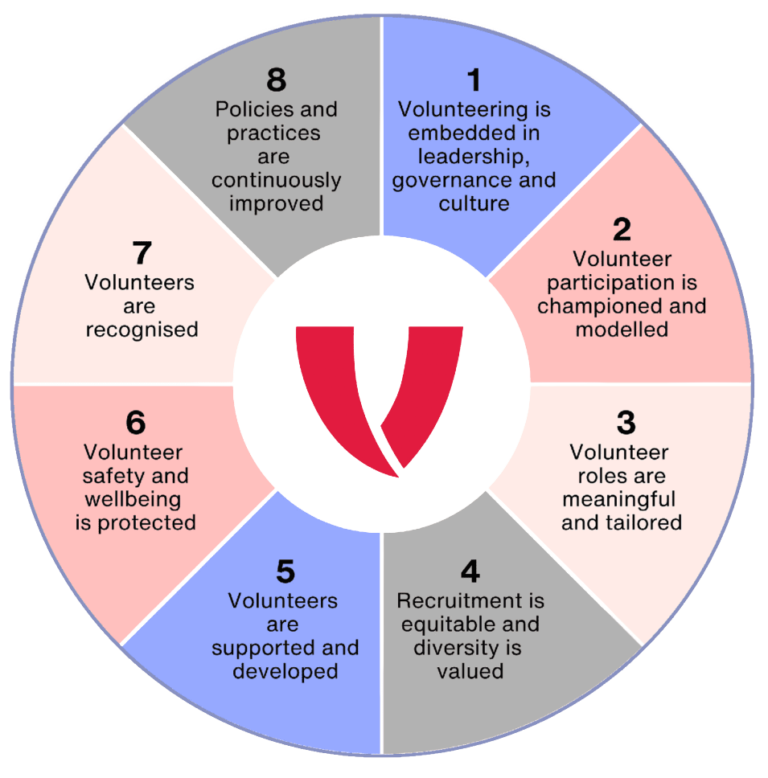
Read more about each of the Standards
Standard 1: Volunteering is embedded in leadership, governance and culture.
The governing body and organisation leaders promote volunteering and implement effective systems to support volunteer participation.
1.1 Responsibilities for engaging, leading and managing volunteer participation are defined and supported.
1.2 Governance and risk management arrangements facilitate safe and meaningful volunteer participation.
1.3 Policies and procedures applying to volunteers are developed with volunteers and communicated and implemented across the organisation.
1.4 Volunteer records are maintained, and volunteers and employees understand their obligations on information sharing, record keeping and privacy.
1.5 Processes are in place to manage relationships with partner agencies in collaborative volunteering activities. (This criterion only applies to organisations or groups working with other organisations in a collaborative activity involving volunteers and/or sharing responsibility for volunteers).
Standard 2: Volunteer participation is championed and modelled Commitment to volunteer participation is set out through vision, planning and resourcing, and supports the organisation's or group's strategic direction.
2.1 The organisation publicly declares its commitment to volunteer participation.
2.2 A volunteering culture is championed and modelled at all levels of the organisation.
2.3 Volunteer participation is part of the organisation’s vision, purpose, goals and objectives and is developed through engagement with volunteers.
2.4 Volunteering programs are supported by adequately resourced volunteer managers or officers.
2.5 Resources (including time, funds, equipment and technology) are allocated for volunteer involvement.
Standard 3: Volunteer roles are meaningful and tailored.
Volunteers are engaged in meaningful roles which contribute to the organisation’s or group’s purpose and meet volunteer interests and preferred style of participation.
3.1 Volunteer roles are designed and negotiated with volunteers, considering the needs and interests of volunteers.
3.2 Volunteer roles contribute to the organisation’s purpose, goals and objectives.
3.3 Volunteer roles are defined, documented and communicated.
3.4 Volunteer roles are reviewed regularly including through feedback and engagement with volunteers about their experience.
Standard 4: Recruitment is equitable and diversity is valued.
Volunteer recruitment and selection strategies meet the needs of the organisation and volunteers; they facilitate and value diversity and promote equity and accessibility.
4.1 Organisations and groups engage volunteers using planned and innovative approaches to attract people with relevant interests, knowledge and skills.
4.2 Potential volunteers are provided with information about the organisation, how volunteers contribute to its purpose and vision, available opportunities and the selection process.
4.3 Volunteers are selected based on their interests, knowledge, skills and suitability for the role, and consistent with anti-discrimination law.
4.4 Diversity, inclusivity and accessibility principles are built into recruitment activities, reflecting and promoting awareness of, and respect for, diversity and inclusion and the inherent value this brings to the organisation.
4.5 Screening processes maintain the safety and security of service recipients, employees, volunteers, and the organisation, in line with legal requirements and regulations.
Standard 5: Volunteers are supported and developed.
Volunteers understand their roles and gain the knowledge, skills and feedback needed to participate safely and effectively.
5.1 Volunteers are provided with relevant induction and training.
5.2 Volunteers’ knowledge and skills are reviewed to identify support and development needs.
5.3 Volunteers are engaged with throughout their time with an organisation or group and provided with supervision and support that enables them to participate fully.
5.4 People with responsibility for volunteers have sufficient time and resources to engage with and provide appropriate and required support.
5.5 Changes to the role of a volunteer are fair and consistent and achieved through engaging with the volunteer.
Standard 6: Volunteer safety and wellbeing is protected.
The health, safety and wellbeing of volunteers is protected and volunteers understand their rights and responsibilities.
6.1 Effective working relationships with employees, and between volunteers, are facilitated.
6.2 Organisations and groups meet their legal and ethical obligations to protect volunteers from harm.
6.3 Processes are in place to protect the health, safety and wellbeing of volunteers in their capacity as volunteers, including relevant insurances.
6.4 Volunteers understand and have access to complaints procedures.
6.5 Complaints, concerns and safety incidents are analysed to identify causes and inform continuous improvement.
Standard 7: Volunteers are recognised.
Volunteer contribution, value and impact are understood, appreciated and acknowledged.
7.1 How volunteers add value to the organisation, service recipients and the community is clearly understood.
7.2 Volunteer effort is measured and acknowledged in the organisation’s reporting and used to demonstrate impact.
7.3 The organisation regularly engages with volunteers about the impact of their contribution.
7.4 Volunteer acknowledgement is appropriate to the volunteer and respectful of cultural values and perspectives.
Standard 8: Policies and practices are continuously improved.
Effective volunteer involvement results from a system of best practice, regular review and continuous improvement.
8.1 Policies and procedures are designed and implemented to effectively guide all aspects of volunteer involvement.
8.2 Volunteer involvement is regularly reviewed in line with the organisation’s evaluation and quality management frameworks.
8.3 The organisation’s performance with volunteer involvement is monitored and reported to the governing body, employees, volunteers, and other stakeholders.
8.4 Opportunities are available for volunteers to provide feedback on their experience and relevant areas of the organisation’s work.
How can you use the Standards?
You can use the Standards in several ways:
- As a general guide to improving practice.
- As guidelines or a checklist to help identify opportunities for making improvements.
- As a framework to assist in planning and establishing a new volunteering program.
- As an audit tool that provides a snapshot of organisational performance.
- As a baseline from which progress in making improvements can be monitored and measured.
Using the Standards helps your organisation/group to effectively recruit, manage and support your volunteers.
A tool to help you meet the National Standards for Volunteer Involvement
Would you like to find out how your volunteer involving organisation is tracking against the National Standards for Volunteer Involvement? A new tool has been designed to help you.
The tool steps you through a self-assessment process on each Standard, providing you with the opportunity to both identify and action areas for improvement. It also provides easy access to a range of resources to assist you throughout the process.
Once you have completed the self assessment, you have the option of progressing to an accreditation process.
If you are interested in complimentary access to this fantastic new tool, please submit an expression of interest.
Masterclass: Applying the refreshed National Standards for Volunteer Involvement (December 2024)
Workshop: National Standards for Volunteer Involvement (June 2024)
Read more on the Refresh
Refreshing the National Standards for Volunteer Involvement was informed by a sector wide consultation process conducted across each state and territory in 2023. Insights gained through the National Strategy for Volunteering consultations also informed the refresh, as well as insights from overseas and other ‘national standards’ arrangements. The project was funded via the Australian Government’s Volunteer Management Activity. The refreshed National Standards have retained the core aims and principles underpinning the previous standards and the eight broad focus areas of the National Standards are the same.